

Held in Light and Wind: Early Spring at Helmsley, by Andrew Jackson

Our Easter gift to you…
More beautiful words from our resident writer, Andrew Jackson. We hope you can steal a moment to relax and let Andrew’s words work their magic as they transport you through the garden.
Over to Andrew…
There are mornings at the turning of March into April when the earth seems to draw a longer breath, as if waking from a deep and complicated dream. The light arrives softly but with intent, slipping between branches, touching stone, lingering on the smallest signs of life. Nothing declares itself outright. Instead, everything suggests. A loosening. A stirring. An insistence that the year is beginning again.
At the garden, this awakening gathers itself within old walls that have watched centuries pass and seasons return in endless variation. The walls hold warmth even on cooler days, catching what little sun there is and offering it back to the garden in small, generous increments. They speak of an earlier purpose, when this was a place of production and order, a kitchen garden bound to the needs of an estate. You can still trace that history in the long lines of the beds and the measured geometry of the paths. Yet time has softened the strictness. The garden has learned to exhale.

At this moment in the year, that exhalation is just beginning.
The light is different now. It no longer sits heavily across the land but moves, searching, illuminating one corner and then another. It rests briefly on the rim of a pot, on the curve of a leaf, on the fine hairs of a stem just breaking through the soil. There is no abundance yet, but there is a sense of gathering. The garden is assembling itself.
In the borders, the soil seems to rise slightly, as though responding to an unseen call. Small green shapes emerge with quiet determination. Alliums form their pale green loops. Fennel begins as a soft blur, hardly there at all. Each plant carries within it the memory of its own fullness, though for now it offers only the faintest outline.

And then there are the tulips.
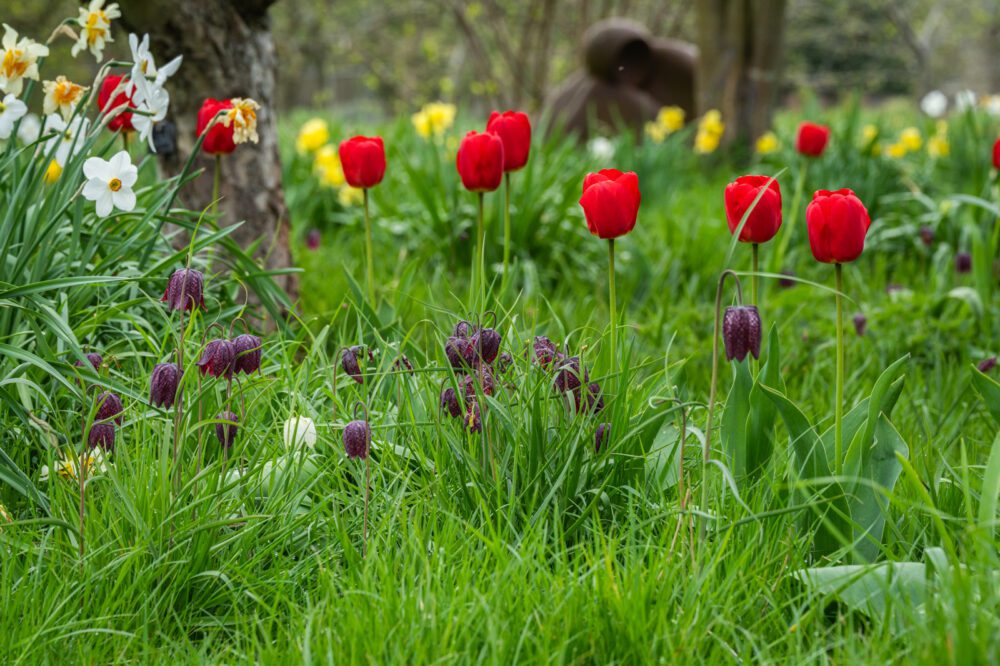
Set in pots along the paths and at thresholds, they draw the eye not through extravagance but through presence. Each one stands slightly apart, contained yet expressive. Some remain closed, their forms taut and elegant, holding their colour in reserve. Others have begun to open, revealing petals that seem almost improbable against the restrained tones of early spring. Deep carmine. Soft apricot. Yellow that catches and holds the light. Some are streaked, feathered, touched by variation that feels both deliberate and accidental.
In pots, they invite a different kind of attention. You can stand close, see the subtle gradations within a single petal, the way colour deepens or fades toward the edge. They are not part of a mass but individuals in conversation with their surroundings.
The wind moves through them constantly.
It is a restless companion at this time of year, never entirely still, carrying with it a lingering coolness even on brighter days. It threads its way along the paths and between the pots, setting the tulips into motion. They lean and lift, bow and return. Nothing is fixed. Nothing is posed. And even in the wind there is beauty.
Perhaps it is because the wind reveals their nature more truthfully than stillness ever could. These are not static forms arranged for admiration. They are living things, responsive and alert, shaped moment by moment by forces beyond themselves. A petal turns and briefly catches the light before slipping back into shadow. A stem bends and recovers. Each movement is small, but together they create a kind of quiet animation that holds the eye.

Elsewhere in the garden, other signs of awakening gather.
The orchard stands on the edge of change. The trees are still mostly bare, their branches tracing delicate patterns against the sky, yet a faint haze of swelling buds softens their outlines. It is not yet blossom, but it is the promise of blossom, held just beneath the surface. The fruit cages wait in a kind of patient readiness, their forms stark but expectant.
Across the beds, early growth begins to connect. What were once isolated shoots start to form relationships, weaving a low tapestry of green that will, in time, become something fuller and more complex. There is a sense of preparation everywhere, as though the garden is assembling the elements it will need for the months ahead.
This is one of the particular gifts of visiting the garden at this point in the year. It is not simply a matter of what is in flower, though there is much to notice and admire. It is the opportunity to witness the process itself. To stand within a place that is becoming.

In the height of summer, a garden can feel complete, almost self contained in its richness. Colour and growth press in from every side, and there is a sense that the work of the season has already been done. But here, now, nothing is finished. Everything is in motion. The garden is open, receptive, still deciding what it will be.
The history of the place deepens that experience. To walk these paths is to move through time as much as space. Generations have worked this ground, tending crops, shaping soil, responding to the same rhythms of light and weather. The walls have absorbed all of that labour and all of those seasons. What stands here now is not separate from that past but continuous with it, another expression of the same enduring cycle.
And it is this continuity that draws you back.
A single visit can never be enough, because the garden you see today will not exist in quite the same way tomorrow. Return in a few weeks and the tulips will be at their fullest, their colours more expansive, their forms more open to the light. The orchard may begin to lift into blossom, softening the air with colour and scent. The borders will thicken, the green deepening and diversifying.
Come again later, and the transformation will continue. What was once tentative will become assured. What was spare will become abundant. Yet even then, the memory of this earlier moment will linger, shaping the way you see it.
For it is here, in this awakening, that the garden reveals something essential about itself. Not just what it is, but how it comes into being. And to witness that, even briefly, is to understand why places like this call us back again and again, asking us to return, to look more closely, and to notice what has changed.
Andrew Jackson
Andrew (pictured below) is a new build gardener and the visionary founder of the New Build Manifesto, a campaign championing better access to and higher quality new build spaces. As an award-winning garden designer and writer who was featured on BBC Gardeners’ World in June, 2025, Andrew embodies the creativity and passion that comes from time spent outdoors, in nature.
Follow Andrew’s journey via the links below:
Scribehound Gardening
@thenewbuildmanifesto
Photo credits – Colin Dilcock, Stephen Barstow
 Filed under: Blog
